Handle failure.
Bound the work.
Build a collector test boundary that distinguishes unavailable data from an empty result, then process a bounded local digest queue with stable ordering.
DEFENSIVE AUTOMATION / LOCAL PRACTICE
Python for Cybersecurity Specialization turns Python fundamentals into careful, testable defensive workflows. Learn through synthetic logs, offline analysis, file integrity, and practical local projects.
One-time purchase · Illustrated PDF + code + lab planner
Independent self-study guide. “Specialization” describes the focused curriculum; no accreditation or certification is awarded.
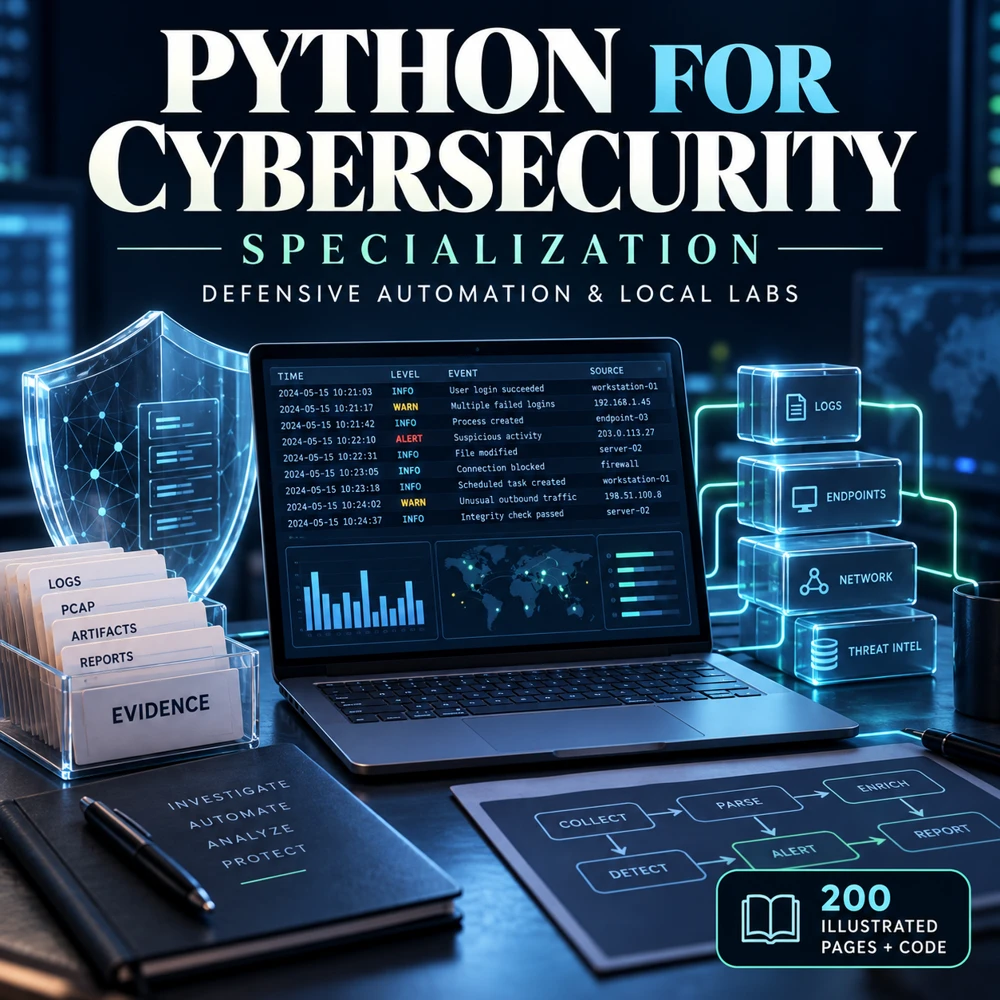
Tested on CPython 3.11.9 and 3.12.14 on Windows. Other platforms, versions, and live integrations were not executed.
BUILD THE HABIT BEFORE THE WORKFLOW
Define the input contract. Keep the source intact. Account for rejected records. Make the rule visible. Give the next reviewer enough context to understand what the tool actually observed.
The course starts with Python basics and progresses toward authentication triage, offline indicator matching, file manifests, and a preview-first reporting pipeline.
Supplied programs use the standard library and controlled local fixtures. No paid API or external target is required.

SIX PARTS. ONE CONNECTED LEARNING PATH.
Every five-page chapter includes a concept and visual model, runnable example with observed output, lab brief, complete reference solution, and verification with interpretation.
THE FINAL SIX PROJECT CHAPTERS
Build a collector test boundary that distinguishes unavailable data from an empty result, then process a bounded local digest queue with stable ordering.
Validate synthetic authentication events and create review candidates. Match IP indicators against a local reference list while preserving observation indexes.
Create a scoped file integrity manifest and finish a JSON Lines reporting tool that previews by default and refuses ordinary output overwrite.
Educational thresholds and matches indicate patterns for review. They do not establish a confirmed incident or production detection coverage.
ACTUAL PAGES FROM THE GUIDE
The 200 pages include original diagrams, illustrative images, code, worked examples, and writing space. The separate planner repeats ten selected pages for convenient printing.
Learn to read bounded bytes, decode deliberately, and preserve source data before analysis.
Open the free 13-page sample ↗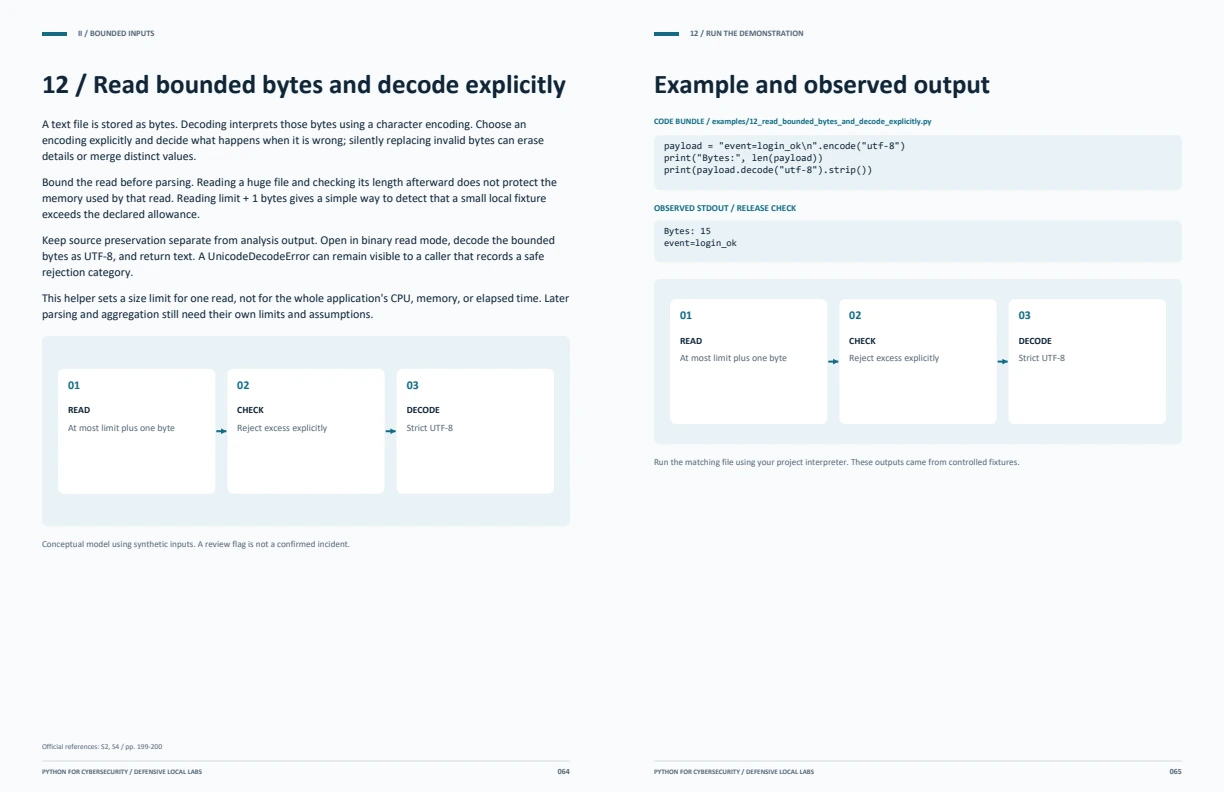
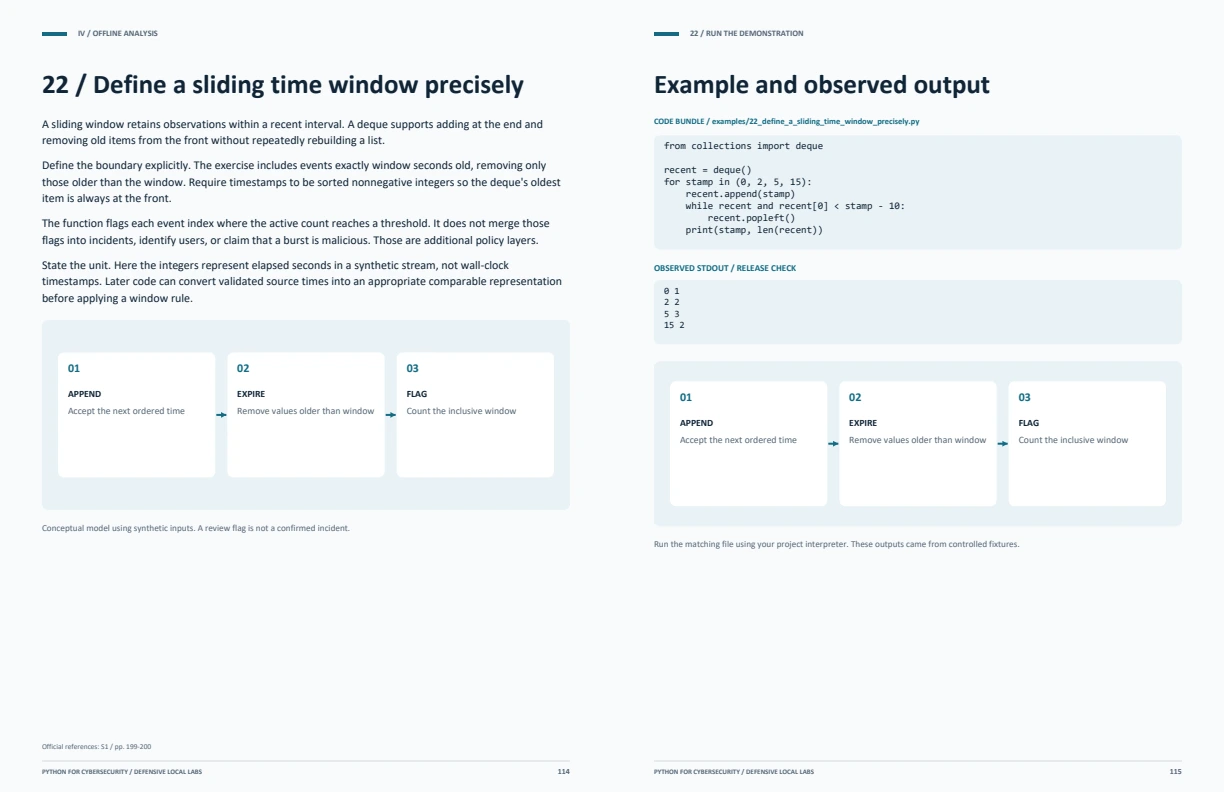
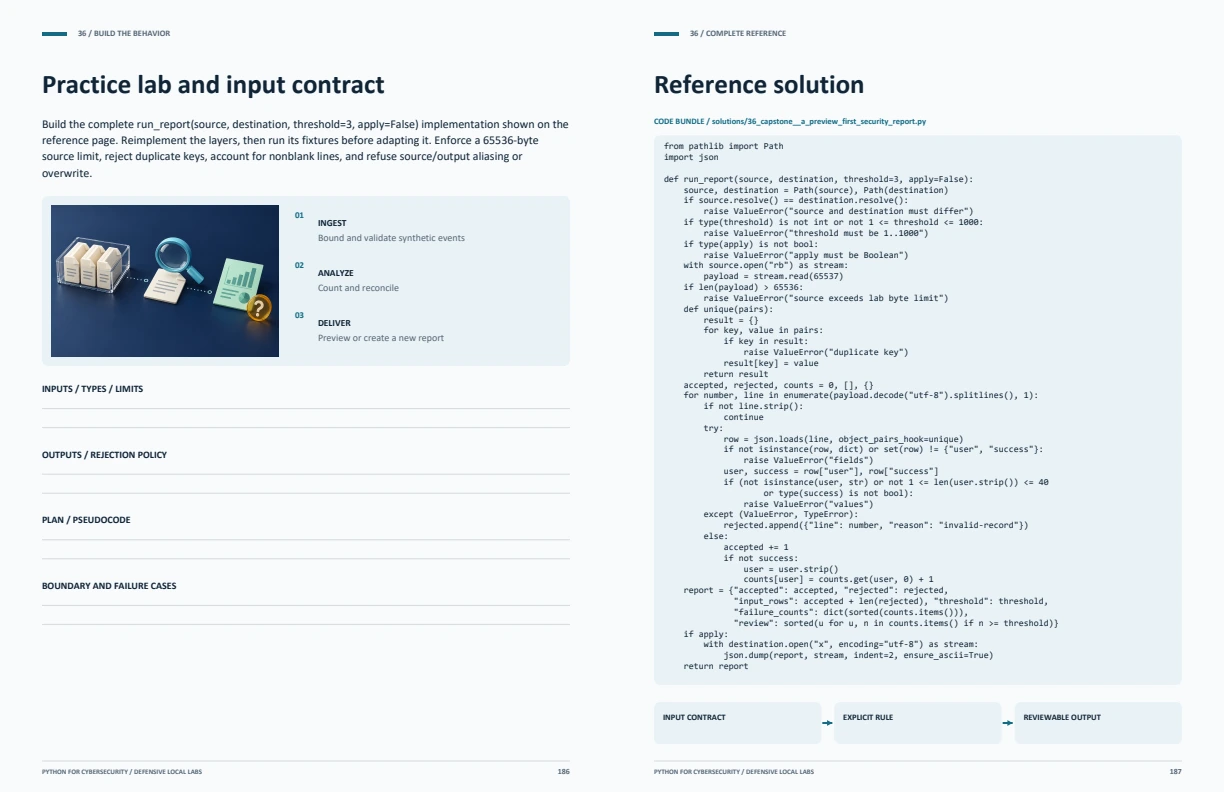
Reduced-size preview. The PDF contains readable text, crisp vector diagrams, and chapter bookmarks.
THE DOWNLOADABLE LEARNING KIT
# Run the course verification
python verify_bundle.py

# Preview a synthetic report
python security_report.py \
  fixtures/auth-clean.jsonl \
  report.json --threshold 2

"mode": "preview"
# No output file created in preview mode.
Shell continuation syntax varies. The bundle README provides a one-line command for ordinary use.
COMPLETE SELF-STUDY EDITION
For beginners ready to move from Python syntax to small, testable tools that process controlled security data.
No job, certification, detection, or security outcome is promised. Read the sample to see the level and format.
$30USD
One-time purchase.
Download and learn at your own pace.
Secure checkout and delivery through Gumroad.
Applicable taxes may be added at checkout.
BEFORE YOU START
No. It is an independent self-study ebook and lab bundle. “Specialization” describes the defensive Python focus. No accreditation, university affiliation, formal certification, or completion credential is included.
Yes. The first chapters cover running scripts, values, text, collections, validation, and functions before moving into structured data and defensive projects. Work through the early labs in order and read the free sample to judge the pace.
Eight opening pages, 36 five-page chapters, and 12 planning/reference pages. Code, diagrams, exercises, and writing space are included. The separate ten-page planner repeats selected main-book pages for convenient printing.
All 72 core programs and 125 verification blocks passed on CPython 3.11.9 and 3.12.14 on Windows. The distributed runner and CLI are checked separately during packaging. Other operating systems, interpreter versions, live security systems, and production integrations were not executed.
No. Supplied exercises use synthetic records, local practice files, in-memory SQLite, and offline address or URL comparisons. The code uses the standard library and requires no paid service, API key, or third-party package.
You may adapt the code for personal and commercial projects. Review the input contract, known limitations, and intended authorized scope, then test your adaptations. Purchase does not grant resale or redistribution rights to the ebook or complete bundle.